
Tips
The unwritten rules of Paris, straight up
The scams you’ll come across, how to spot them and what to do; the metro, eating out, etiquette, staying alert at night. What you’d tell a friend the day before they leave.
 Android: coming soon to Google Play
Emergency numbers
Neither the app nor this site is an emergency service. If you are in immediate danger, call directly: 112 works from any phone.
Exploring
Don't try to see it all
The Louvre, the Eiffel Tower, Montmartre, Versailles, the Latin Quarter: trying to cram them all into two or three days just means going home exhausted without having really enjoyed any of it. Pick a few visits and take the time to enjoy them. There is no perfect itinerary, and the best moments of a trip are often the ones you never planned.
4 more practical tips in the app
Off the beaten track
The 11th, 13th, 19th and 20th arrondissements are underrated by visitors. They show a more everyday, greener and far less crowded Paris than the centre: set aside a day for them, or at least half a day.
4 more practical tips in the app
An evening walk
Paris looks completely different once it is lit up. Keep at least one evening for walking with no particular goal: the banks of the Seine, Montmartre, the Marais or the streets around the Louvre take on a whole new look.
2 more practical tips in the app
Shopping
The Champs-Élysées are worth seeing once, but they are not where the most interesting shopping is: the avenue is mostly lined with big chains. For small shops, independent designers and cafés, head for neighbourhood streets instead.
3 more practical tips in the app
Visiting in August
Don't rule out August: many Parisians go on holiday, the city empties and becomes much calmer, and the major museums and monuments stay open. It is a good time to discover Paris, as long as you know its summer habits.
3 more practical tips in the app
Food & drink
Water: tap and carafe
There is no need to buy bottled water: tap water in Paris is perfectly safe to drink. In a restaurant, ask for "une carafe d'eau": it is free whenever you are having a meal. If you don't specify, you will often be served bottled water, which you pay for, sometimes at a very high price.
2 more practical tips in the app
Eating well on a budget
There is no need to eat at a restaurant for every meal: most Parisians eat at home or grab a sandwich from a bakery. Better a really good restaurant from time to time than an average one every day, and Paris has no shortage of average ones.
3 more practical tips in the app
Choosing where to eat
Avoid eating right next to the major tourist sites. You don't need to go far: a five- to ten-minute walk is often enough to find much better food, and cheaper too.
2 more practical tips in the app
Taking your time over meals
Don't rush your meals. Have a coffee, sit out on a terrace, watch the world go by: it is part of the trip, not time wasted. Nothing says you have to be somewhere else every twenty minutes.
2 more practical tips in the app
Transport
The metro and the Navigo pass
The metro is the fastest way across Paris: 14 lines, from about 5:30 a.m. to 1:15 a.m. (2:15 a.m. on Friday and Saturday nights). For occasional trips, load t+ tickets onto a Navigo Easy card; for a longer stay, a Navigo pass (weekly or daily) is often the better deal.
3 more practical tips in the app
RER and airport links
The RER lines (A to E) cross Paris and its suburbs. For Charles-de-Gaulle airport, the RER B is direct and cheap; for Orly, the Orlyval or the T7 tram connects to the RER. Avoid drivers who approach you inside the terminal: only take taxis from the official rank.
2 more practical tips in the app
On foot and by bike
Paris is compact and beautiful on foot: many sights are fifteen minutes apart. For longer distances, Vélib' shared bikes are handy. Stay alert to cycle lanes and look both ways: traffic can come from unexpected directions.
Etiquette & phrases
The right reflexes
In Paris, politeness opens every door. Always say "Bonjour" when entering a shop, café or restaurant and "Au revoir" when leaving: it is expected and appreciated, just like "s'il vous plaît" and "merci". A word of French, however imperfect, completely changes how you are received; many Parisians will then happily switch to English.
4 more practical tips in the app
Useful phrases
A few simple phrases are enough to get by and to make a good impression. Here are the essentials, with their meaning in English.
6 more practical tips in the app
Staying aware
Staying aware at night
Paris is generally safe, but as in any big city a few habits help at night. Awareness is about the situation, not the neighbourhood: stay on busy, well-lit streets, keep your phone discreet, and trust your instinct if a place feels off.
3 more practical tips in the app
Protecting your belongings
The main risk for visitors is not assault but pickpocketing, on the metro, in the big stations and at tourist sites. No need to panic, common sense is enough: keep documents, phone and bank card in an inner pocket or a closed bag worn in front, and never leave a bag on the back of a chair on a terrace.
3 more practical tips in the app
Scams
Scams to know about
They mostly happen around the big sights, and always the same way. Recognising them is almost enough to beat them.
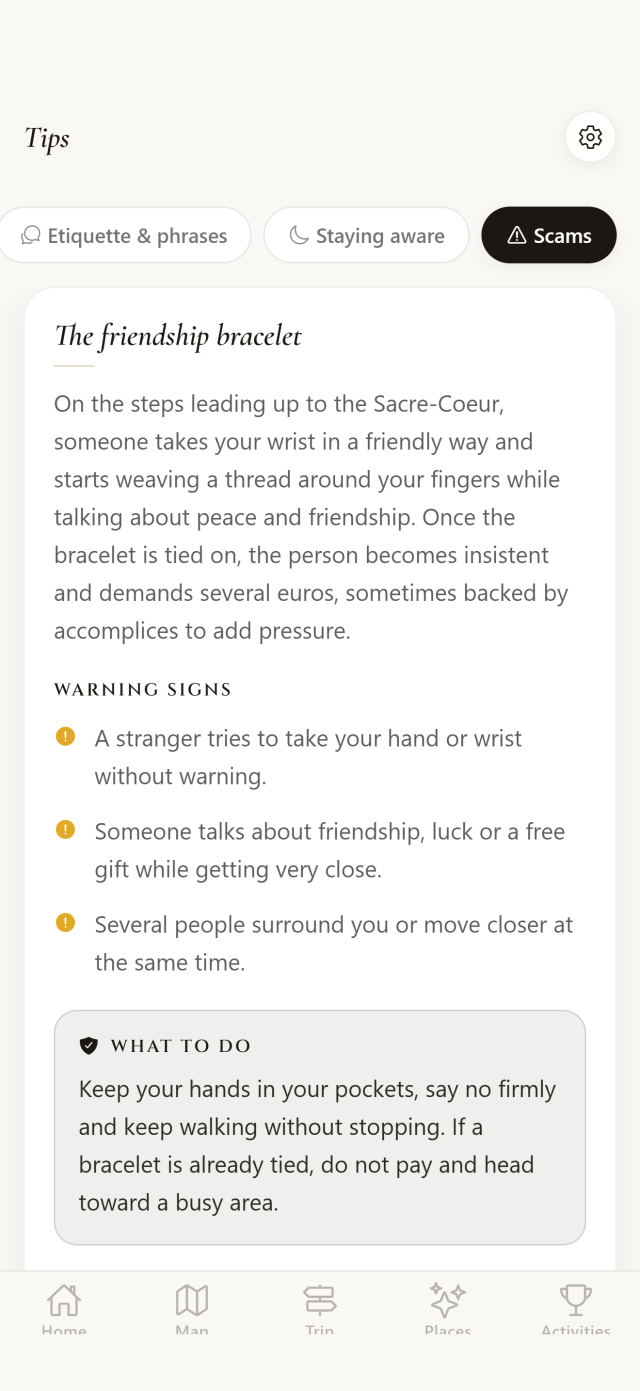
The friendship bracelet
On the steps leading up to the Sacre-Coeur, someone takes your wrist in a friendly way and starts weaving a thread around your fingers while talking about peace and friendship. Once the bracelet is tied on, the person becomes insistent and demands several euros, sometimes backed by accomplices to add pressure.
Warning signs
- A stranger tries to take your hand or wrist without warning.
- Someone talks about friendship, luck or a free gift while getting very close.
- Several people surround you or move closer at the same time.
What to do
Keep your hands in your pockets, say no firmly and keep walking without stopping. If a bracelet is already tied, do not pay and head toward a busy area.
Sacré-Cœur · Montmartre · Place du Tertre
The fake deaf-mute petition
Someone hands you a clipboard, pretending to be deaf and mute, and asks you to sign a petition for a charitable cause. While you sign or look for a pen, an accomplice may go through your bag, or you are then pressured to give a cash donation.
Warning signs
- You are shown a clipboard with a list of signatures and amounts already filled in.
- The person stays silent but becomes insistent about getting money.
- A group operates together around tourist sites.
What to do
Refuse to sign, keep your bag closed and in front of you, and walk away immediately. Never take out your wallet for a street donation.
Tour Eiffel · Musée du Louvre · Trocadéro · Notre-Dame
The found gold ring
Someone picks up a gold-colored ring in front of you and asks if it is yours, then insists on giving it to you, claiming it is real gold. After putting it in your hand, they ask for a few euros for food or drink, even though the ring is worthless.
Warning signs
- Someone pretends to find a valuable object right at your feet.
- You are offered an unexpected gift, then asked for money in return.
- The scene happens along the Seine or on a tourist bridge.
What to do
Say it is not yours, do not touch the object, and keep walking. Do not give any money, not even a small amount.
Pont des Arts · Quais de Seine · Tour Eiffel · Champ de Mars
The shell game (three cups)
A dealer quickly moves three cups or cardboard pieces hiding a ball and invites passers-by to bet where it is. Accomplices in the crowd appear to win easily to lure you in, but the game is rigged and you always lose your stake.
Warning signs
- A crowd where some players win large sums very quickly.
- Lookouts watch for police and the game suddenly packs up.
- You are warmly encouraged to bet more and more.
What to do
Never bet and do not stop to watch, as pickpockets work the crowd. Keep your belongings close and move on.
Pont au Change · Trocadéro · Sacré-Cœur · Quais de Seine
The fake survey or fake charity
Smiling people approach you with an official-looking badge or T-shirt for a survey or a collection for children or an NGO. They keep you busy with questions while an accomplice moves in, or they push you to sign and then make an immediate cash donation.
Warning signs
- A collection that demands cash on the spot, with no receipt or verifiable information.
- They insist on holding your attention and getting physically close to you.
- The badge or document looks homemade or unclear.
What to do
Politely decline, do not give cash in the street, and make donations only through the charity's official website. Watch your bag during any interaction.
Musée du Louvre · Notre-Dame · Champs-Élysées · Tour Eiffel
Pickpockets on the metro and RER B to CDG
On crowded metro trains and the RER B toward Charles-de-Gaulle airport, thieves use the crush when boarding and getting off to go through bags and pockets. They often work in teams, one bumping into you while another lifts your phone, wallet or passport.
Warning signs
- A sudden shove or a blockage right as the doors open or close.
- People standing very close to you for no reason in a train with free space.
- A group that boards and exits together, staying near tourists loaded with luggage.
What to do
Wear your bag closed and in front of you, and keep your phone and documents in an inner pocket. Stay alert at stops and hold your belongings tightly during any jostling.
RER B · Gare du Nord · Châtelet-Les Halles · Ligne 1
The tampered ATM
Near some tourist sites, certain ATMs may be fitted with a card-skimming device and a tiny camera filming your PIN. Sometimes a helpful-looking stranger offers to assist you with the withdrawal, just long enough to memorize your code and spot your card.
Warning signs
- A card slot that wobbles, sticks out or looks added on.
- A raised keypad or a small camera poorly hidden above it.
- A person who steps in to help you without being asked.
What to do
Prefer ATMs located inside banks, cover the keypad with your hand and refuse any help. If in doubt, cancel the transaction and use a different machine.
Champs-Élysées · Gare du Nord · Montmartre · Opéra
The fake taxi
Outside airports and train stations, a driver offers you a ride, posing as an official taxi without a meter or visible license. He then announces a very high fixed price to reach central Paris, sometimes demanding a cash payment once you arrive.
Warning signs
- A driver who solicits you inside the terminal instead of at the official taxi line.
- No taxi light on the roof, no meter and no displayed license.
- A quoted fare well above the official flat rate into Paris.
What to do
Take taxis only from the official rank or a recognized booking app. From CDG, the flat fare is 56 € to the Right Bank and 65 € to the Left Bank. Licensed taxis never solicit inside the terminal, so refuse any offer made indoors.
Gare du Nord · Gare de Lyon · Châtelet-Les Halles · RER B
The app
All this, and more, in your pocket
Full reviews, stories, opening hours, crowds hour by hour, a trip planned in three taps: free, ad-free and readable offline.
Android: coming soon to Google Play